
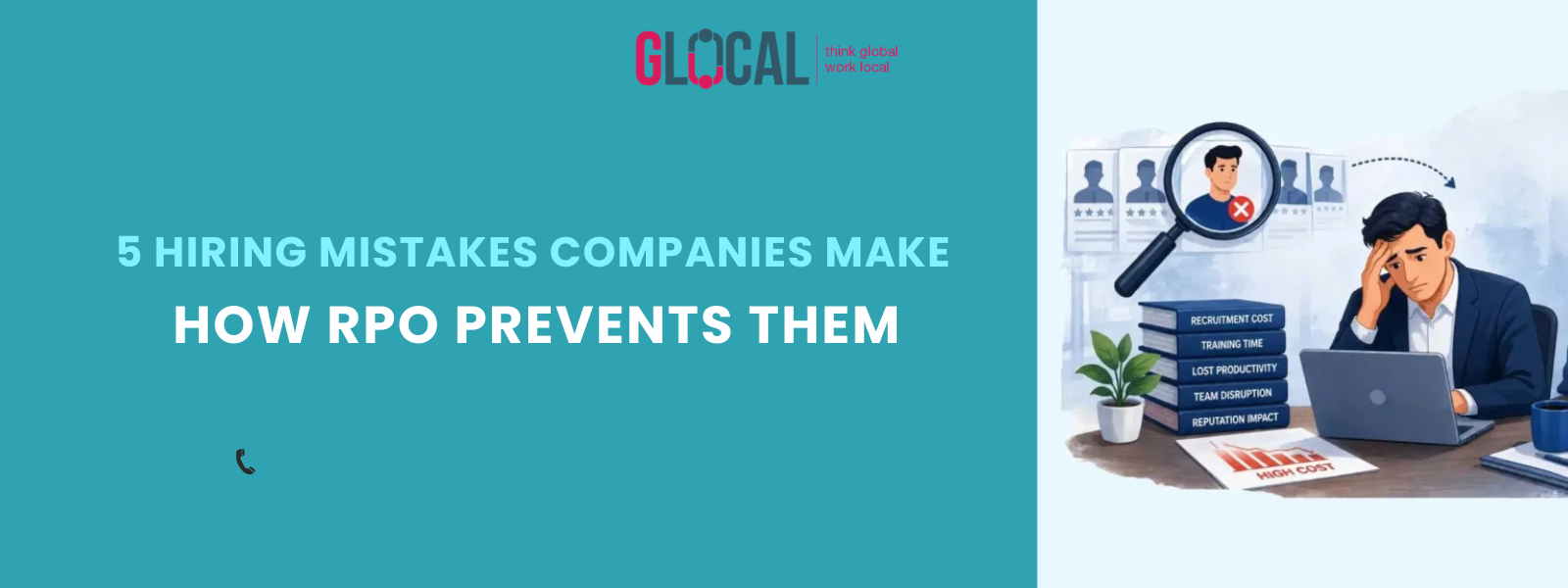
5 Hiring Mistakes Companies Make — and How RPO Prevents Them
Hiring looks straightforward on paper. Post a role, screen candidates, make an offer. In practice, it routinely costs companies more than they expect — in time, money, and the hidden drag of a bad hire sitting in a critical seat.
RPO recruitment exists precisely because the standard hiring model breaks down at scale, under pressure, and in specialised talent markets. Here is where it breaks down most often.
1. Hiring for Urgency, Not Fit
A role sits open for six weeks. The hiring manager is stretched. Leadership wants it filled. So the bar quietly lowers, and the first acceptable candidate becomes the chosen candidate.
Speed-driven hiring is one of the most expensive patterns in talent acquisition. The US Department of Labor estimates a bad hire can cost up to 30% of that employee’s first-year earnings — and that figure does not account for team disruption, client impact, or the time spent restarting the search.
RPO recruitment changes the dynamic by building talent pipelines before roles become urgent. An experienced RPO company maintains active candidate pools in your target functions, which means when a position opens, qualified candidates are already in conversation — not cold-sourced from scratch. Urgency stops driving the decision.
2. Inconsistent Screening Across Hiring Managers
In most internal recruiting setups, screening consistency is assumed but rarely enforced. One hiring manager runs structured competency interviews. Another relies on gut feel. A third prioritises culture fit above everything else and has no clear definition of what that means.
The result is a process that produces inconsistent hires and exposes the company to compliance risk. When interview criteria are not standardised, candidate evaluation becomes subjective — and subjectivity creates both quality problems and legal liability.
RPO companies implement structured hiring frameworks across every role and every hiring manager. Standardised scorecards, defined competency benchmarks, and documented evaluation criteria make the process repeatable. Quality becomes a system output, not a hiring manager variable.
3. Treating Employer Brand as a Marketing Problem
Most companies acknowledge employer branding matters. Few treat it as a talent acquisition function. The careers page gets a refresh every few years. A handful of Glassdoor reviews go unanswered. Job descriptions are copied from the last time the role was open.
Strong candidates — particularly passive ones — evaluate your company well before they apply. If your employer brand does not reflect a credible, compelling place to work, the best talent self-selects out before your recruiter ever reaches them.
RPO recruitment addresses this at the source. A capable RPO company audits your candidate-facing materials, improves job description quality, manages candidate communication touchpoints, and builds the employer brand presence that attracts stronger applicants — not just more of them.
4. Ignoring the Cost of an Open Role
Most companies track cost-per-hire. Far fewer track the cost of vacancy — what the business loses each week a critical role sits unfilled. For revenue-generating positions, that number is concrete. For operational roles, it shows up as team burnout, delayed projects, and work that quietly redistributes onto people already at capacity.
A 45-day time-to-fill might look acceptable in an HR report. Multiplied across ten open roles simultaneously, it represents a significant and largely invisible drag on business performance.
RPO companies treat time-to-fill as a core delivery metric, not an afterthought. Dedicated sourcing capacity, structured pipelines, and proactive talent engagement consistently reduce time-to-fill — which means less vacancy cost and less pressure on the teams carrying the load.
5. Scaling Recruiting Reactively
Headcount plans change. A new market opens. A product launch accelerates hiring. A reorg creates ten new roles in a quarter. Internal recruiting teams built for steady-state hiring are rarely equipped to absorb sudden volume — and the response is usually to either slow the business down or compromise on quality.
Reactive recruiting creates a permanent cycle: underprepared for surges, overstaffed in slow periods, and never quite aligned with where the business is actually going.
RPO recruitment is designed for this volatility. An established RPO company scales recruiting capacity up or down in line with your business needs — without the lag of hiring, onboarding, and training internal recruiters each time volume shifts. The infrastructure is already there.
The Pattern Behind All Five
These mistakes share a root cause: treating hiring as a transactional, reactive function rather than a strategic, operational one. Each mistake is individually manageable. Together, they compound — producing higher costs, longer timelines, weaker hires, and a recruiting function that is always catching up.
RPO recruitment reframes hiring as a managed process with defined inputs, consistent execution, and measurable outcomes. For companies serious about talent as a competitive advantage, the question is not whether RPO makes sense — it is how much the current approach is already costing them.
Written & Verified By:
Agrima Anand

A recruitment professional with 6.5 years of RPO experience spanning healthcare, real estate, manufacturing, IT, and technology industries. Skilled in developing and executing strategic hiring initiatives, streamlining recruitment operations, and partnering with organizations to attract and retain top talent at scale.
Know About the Author

How Strategic Staffing Partners Support Healthcare Growth
Older post
The Impact of RPO on Diversity Hiring: Data and Strategies
Newer postYou might also like


